
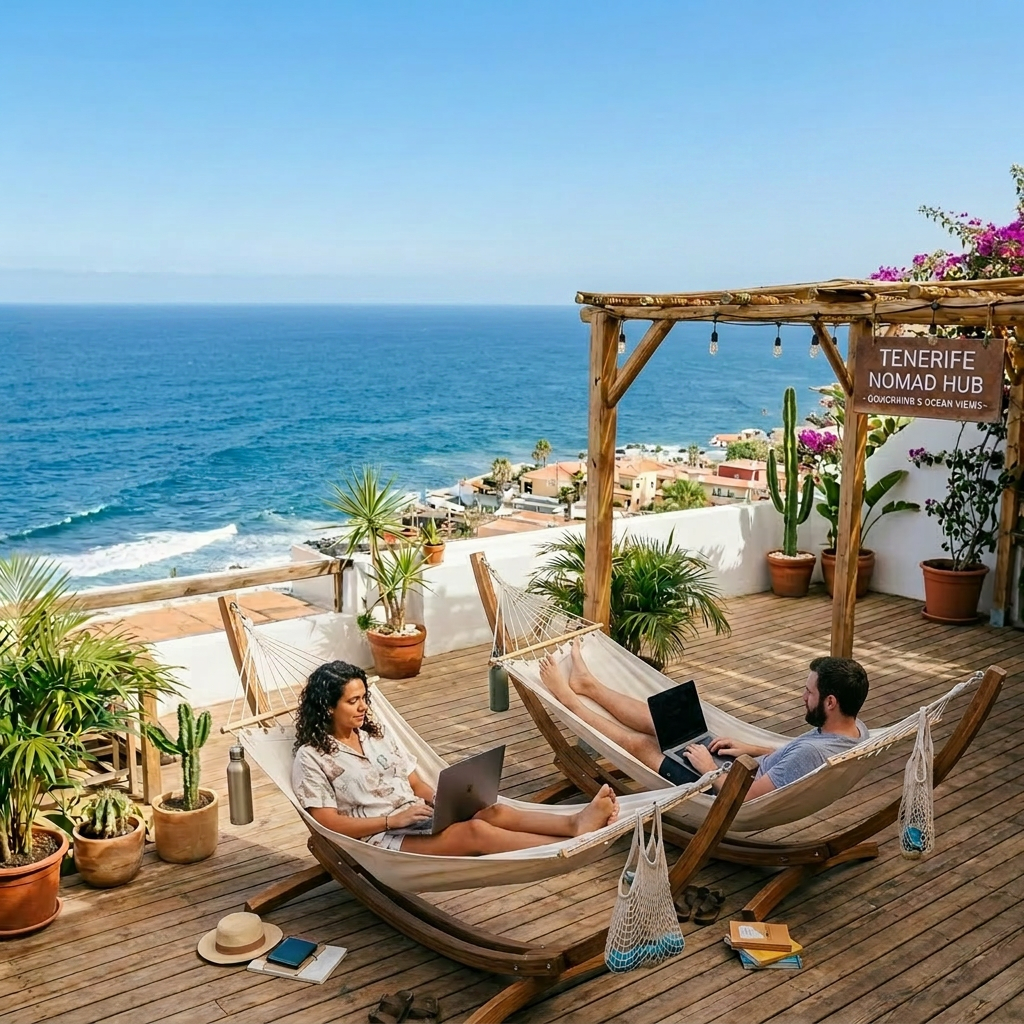

Imagine finishing your morning calls with a view of the Atlantic, grabbing lunch at a harbour-side restaurant for €10, and spending your afternoon on a volcanic beach before heading back to your laptop for the European close.
This isn’t a fantasy. This is a Tuesday in the Canary Islands.
The archipelago has quietly become one of Europe’s top digital nomad destinations — and in 2026, it’s better than ever. Year-round sunshine, fast internet, low cost of living compared to mainland Europe, and direct flights from almost every major city on the continent make the Canary Islands a serious option for remote workers.
This guide covers everything you need to know to make the move — even temporarily.
Why the Canary Islands for Digital Nomads?
☀️ Weather

The Canary Islands sit at the same latitude as the Sahara Desert — which means warm, sunny weather 365 days a year. Average temperatures range from 18°C in winter to 28°C in summer. No dark, grey European winters. No seasonal depression. Just permanent spring.
✈️ Connectivity
Direct flights to the Canary Islands from London, Amsterdam, Berlin, Paris, Stockholm, and dozens of other European cities — often for under €100 return. The islands are technically Spain (EU), so no visa requirements for EU citizens and easy entry for most others.
💻 Internet
Fibre internet has expanded significantly across the islands in recent years. Most coworking spaces and hotels offer speeds of 100–500 Mbps. Even smaller towns now have reliable connectivity.
💰 Cost of Living
Significantly cheaper than mainland Spain, and dramatically cheaper than northern European cities. A comfortable nomad lifestyle — good accommodation, eating out regularly, activities — can be maintained for €1,500–2,500 per month depending on the island and lifestyle.
🇪🇺 Legal Status
The Canary Islands are part of Spain and the EU — but have a special economic status with lower VAT and taxes. Spain’s Digital Nomad Visa (launched 2023) allows non-EU remote workers to legally live and work in Spain for up to 5 years.
Best Islands for Digital Nomads
1. Gran Canaria — Best Overall ⭐⭐⭐⭐⭐
Las Palmas de Gran Canaria has become the undisputed digital nomad capital of the Canary Islands — and one of the top nomad cities in Europe. The combination of a real city (1 million inhabitants), a 3km urban beach, excellent coworking infrastructure, a strong international community, and year-round sunshine is hard to beat anywhere in the world.
Why nomads love it:
- Largest and most established nomad community in the islands
- Best coworking infrastructure
- Real city amenities — gyms, supermarkets, hospitals, culture
- Playa de Las Canteras — one of the best urban beaches in Europe
- Excellent restaurant and café scene for working remotely
- Lower cost of living than Tenerife’s resort areas
Average monthly cost: €1,400–2,000
👉 Find long-stay apartments in Las Palmas on Booking.com
2. Tenerife — Best for Lifestyle ⭐⭐⭐⭐⭐
Tenerife offers two very different nomad experiences depending on where you base yourself:
Santa Cruz / La Laguna (North): The authentic city experience — university town energy, great cafés, cultural life, and a growing nomad scene. More affordable than the south.
Costa Adeje / Los Cristianos (South): Resort lifestyle with guaranteed sunshine — better for those who prioritise beach access and outdoor activities over city amenities.
Why nomads love it:
- Largest island with the most variety
- Strong flight connections from across Europe
- Mix of city life (north) and resort lifestyle (south)
- Excellent nature — Teide, Anaga forest, dramatic coastline
Average monthly cost: €1,500–2,200
👉 Find long-stay apartments in Tenerife on Booking.com
3. Lanzarote — Best for Inspiration ⭐⭐⭐⭐
Lanzarote’s extraordinary volcanic landscape and unique artistic heritage (thanks to César Manrique) make it one of the most inspiring places to work remotely in Europe. The island is quieter and more intimate than Gran Canaria or Tenerife — perfect for focused work and creative projects.
Why nomads love it:
- Unique, inspiring landscape unlike anywhere in Europe
- Quieter and less touristy than the larger islands
- Growing coworking scene in Puerto del Carmen and Arrecife
- Strong surf and outdoor sports community
Average monthly cost: €1,300–1,900
👉 Find long-stay apartments in Lanzarote on Booking.com
4. Fuerteventura — Best for Outdoor Lifestyle ⭐⭐⭐⭐
If your ideal nomad life involves surfing before breakfast, working through the afternoon, and kitesurfing at sunset — Fuerteventura is your island. The nomad infrastructure is less developed than Gran Canaria or Tenerife, but the outdoor lifestyle and beach access are unmatched.
Why nomads love it:
- Best beaches in the Canary Islands
- World-class windsurfing and kitesurfing
- Quieter and more relaxed pace of life
- Lower cost of living than the larger islands
Average monthly cost: €1,200–1,800
👉 Find long-stay apartments in Fuerteventura on Booking.com
Best Coworking Spaces in the Canary Islands
Gran Canaria
- Talleres Palermo (Las Palmas) — the most established nomad hub on the island, with a strong community and regular events
- La Maquinista (Las Palmas) — creative space in a converted industrial building
- Coworking Las Palmas — central location, reliable internet, flexible day passes
Tenerife
- Espacio Open (Santa Cruz) — modern, well-equipped, strong community
- The Corner (Costa Adeje) — popular with south-based nomads, beach-adjacent
- Impact Hub Tenerife (La Laguna) — focus on sustainability and social impact projects
Lanzarote
- Lanzadera Coworking (Arrecife) — the main hub in the capital
- WorkHub Lanzarote (Puerto del Carmen) — better located for resort-based nomads
Fuerteventura
- Coworking Corralejo — small but well-connected, popular with surf nomads
- Puerto Nomad (Puerto del Rosario) — newer space in the island capital
Cost of Living Breakdown (Monthly)
| Expense | Budget | Mid-range | Comfortable |
|---|---|---|---|
| Accommodation | €500 | €800 | €1,200+ |
| Food & dining | €300 | €500 | €700 |
| Coworking | €80 | €150 | €200 |
| Transport | €50 | €100 | €200 |
| Activities | €50 | €150 | €300 |
| Total | €980 | €1,700 | €2,600 |
Prices based on Las Palmas de Gran Canaria — other islands are similar or slightly lower.
Internet & Connectivity
Speed
- Coworking spaces: 100–500 Mbps (fibre)
- Hotels and apartments: 50–200 Mbps typical
- Cafés: variable — test before committing to a work session
Best Providers
- Movistar — best coverage across all islands
- Orange — good urban coverage, competitive SIM plans
- Másmóvil — budget option, good for data-heavy users
SIM Cards
Pick up a Spanish SIM on arrival at any phone shop or supermarket. A monthly data plan (20–50GB) costs €10–25. Roaming within the EU is included.
Visa & Legal Information
EU Citizens
No visa required — you can live and work in Spain indefinitely as an EU citizen.
Non-EU Remote Workers — Spain Digital Nomad Visa
Spain launched its Digital Nomad Visa in 2023, specifically designed for remote workers:
- Stay up to 5 years (renewable)
- Must earn minimum €2,334/month from non-Spanish sources
- Reduced tax rate (24% flat rate for first 4 years)
- Apply at Spanish consulate in your home country
Always consult a qualified immigration lawyer for current visa requirements — regulations change.
Where to Stay as a Digital Nomad
Short-term (1–4 weeks)
Hotels and aparthotels with good Wi-Fi are the easiest option. Look for properties that explicitly mention “remote work” or “business facilities.”
👉 Browse nomad-friendly hotels in Gran Canaria on Booking.com
Medium-term (1–3 months)
Furnished apartments via Airbnb, Idealista, or local Facebook groups. Always test the internet speed before committing.
Long-term (3+ months)
Local rental market via Idealista.com or Fotocasa.es — significantly cheaper than short-term platforms. Expect to pay 1–2 months deposit plus first month’s rent upfront.
Download the Complete Digital Nomad Guide

Want the full offline resource — with neighbourhood maps, coworking space reviews, apartment hunting tips, and a month-by-month cost tracker?
📥 Download the Canary Islands Digital Nomad PDF Guide — €9.99
Everything you need to plan your remote work adventure, in one downloadable guide.
Ready to Make the Move?
The Canary Islands offer something rare: a genuinely world-class quality of life at a fraction of the cost of northern Europe, combined with reliable infrastructure, EU legal status, and year-round sunshine.
Whether you’re planning a month-long workation or a permanent base, the islands deliver.
👉 Browse nomad-friendly accommodation across the Canary Islands on Booking.com — filter by long stay, kitchen facilities, and free Wi-Fi to find your perfect remote work base.
Visa regulations and tax rules change frequently. Always verify current requirements with official Spanish government sources or a qualified immigration lawyer before making decisions.
Related Articles:
- Where to Stay in Gran Canaria: Best Areas & Hotels
- Best Hotels in Tenerife with Ocean View
- Best Beaches in Fuerteventura
visa cost of living Canary Islands workation Canary Islands remote work beach nomad lifestyle long stay Canary Islands Canary Islands 2026 travel and work Spain